Depth maps are often computed, then left trapped in flat interfaces.
Single images and videos can now yield useful depth estimates, but most workflows stop at visualization overlays or offline processing. The latent spatial structure is present, yet it rarely becomes something directly navigable.
DepthShift focuses on that gap. It takes a flat media source plus depth data and asks how little machinery is required to turn the result into a convincing spatial object in both browser and headset.
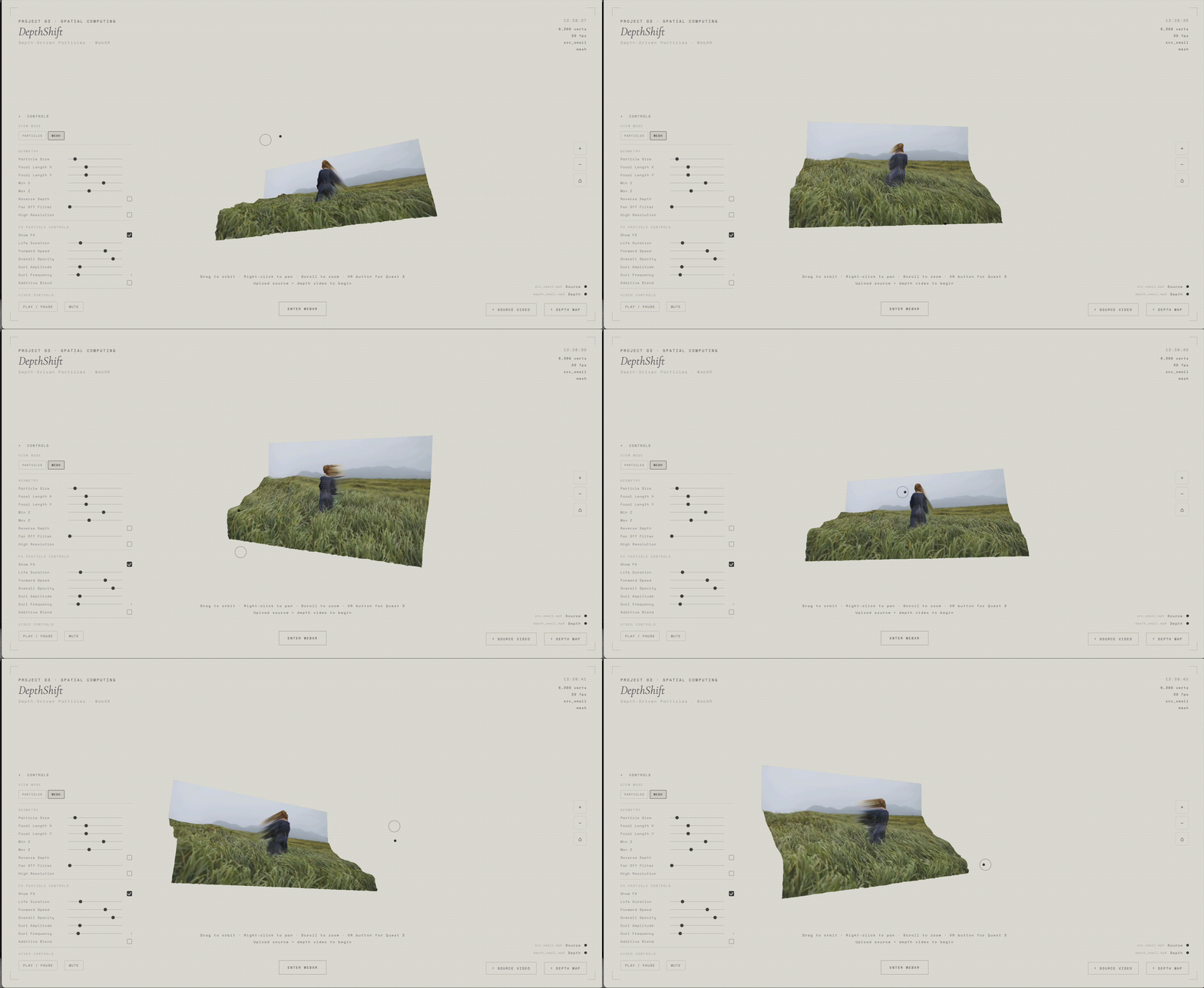
A bridge between flat media and situated holograms.
DepthShift sits at the intersection of browser graphics and mixed reality. It borrows from point-cloud aesthetics, but its goal is less about faithful reconstruction than about fast translation: take an ordinary piece of media and let it behave like a lightweight 3D apparition.
The Quest 3 companion pushes that logic further. Once the same depth field can be anchored through plane detection and manipulated with hand tracking, the experiment stops being only a viewer and starts becoming a spatial media primitive.
Extrude a dense particle grid along the depth axis.
A source image or video is paired with a depth map and passed through a custom GLSL vertex shader. The shader displaces a dense particle grid along Z per pixel, producing an orbitable point cloud that reads as both image and volume.
The browser version emphasizes inspection and control. The WebXR version reuses the same depth-derived mesh logic but anchors it to real-world surfaces on Quest 3, with plane detection and hand tracking providing the bridge from representation to placement.
Shader-driven depth reprojection across browser and headset.
A small shader can open a large spatial jump.
DepthShift shows how far a lightweight reprojection technique can go before full reconstruction is necessary. The result is not a full model, but it is spatial enough to change how the source media is perceived and handled.
It also established a practical bridge between browser graphics work and later XR experiments. Once plane detection and hand tracking were in place, headset deployment stopped feeling separate from the rest of the stack.