Photographs usually stop at depiction instead of becoming places.
Architectural images capture surface and mood, but they rarely yield something you can traverse without a heavier reconstruction pipeline. Marble explores a faster route from reference imagery to spatial world.
The question is simple: how little capture is enough to recover a convincing sense of a place? In this case, a handful of images becomes an explorable proxy for a specific Montreal interior.
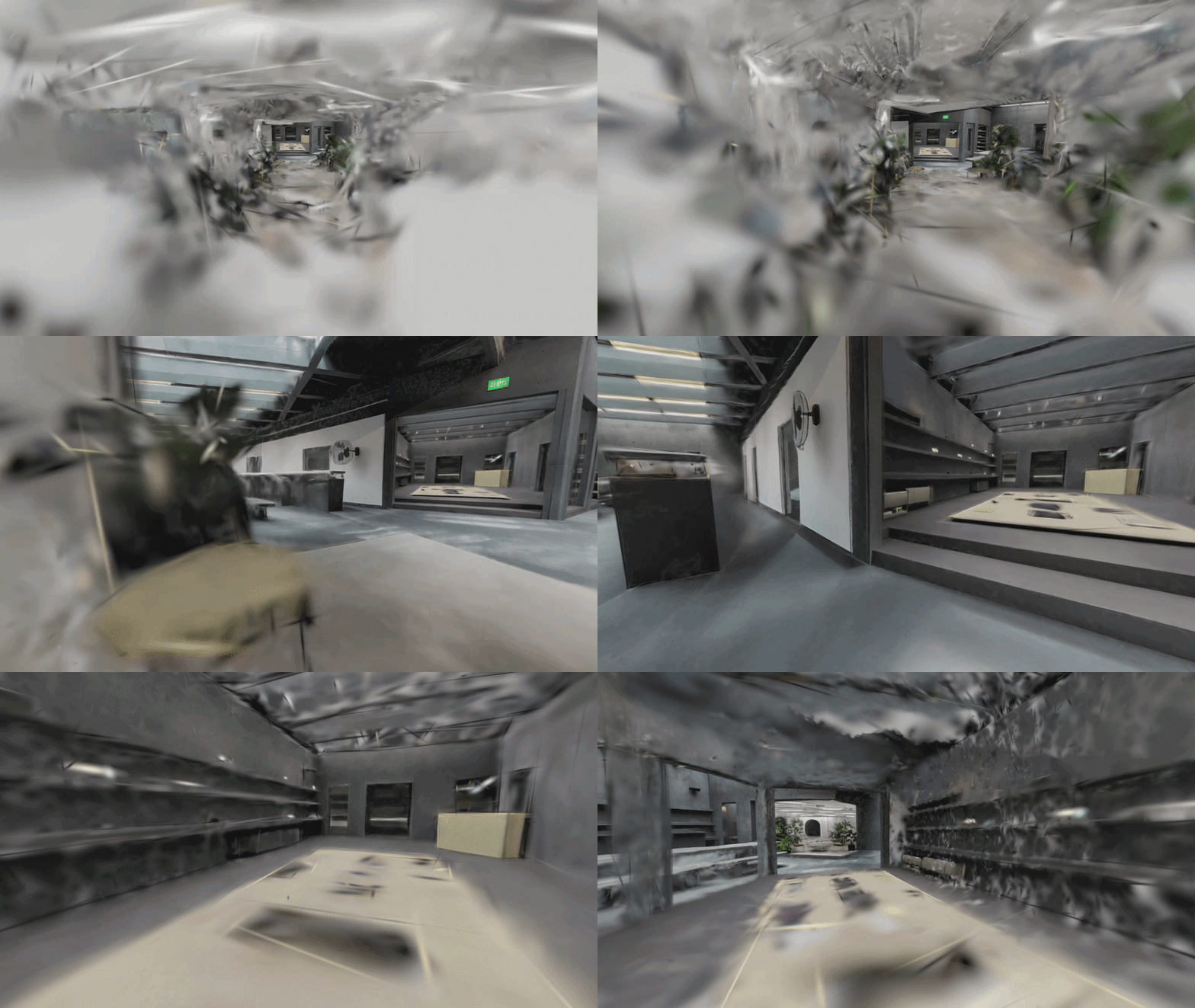
Architecture translated through a world model.
The source subject is David Chipperfield’s brutalist SSENSE flagship in Montreal, a space with enough material contrast and spatial rhythm to stress-test generative reconstruction. The project uses that architecture as a benchmark for atmosphere as much as geometry.
Marble also marks an early world-model experiment in the Spatial Index sequence. It shifts the stack from reconstruction-by-capture toward reconstruction-by-inference, testing what contemporary models can synthesize from sparse visual evidence.
Multi-image reference in, navigable `.spz` world out.
Reference photos of the SSENSE interior are submitted to World Labs’ Marble model, which reconstructs the environment into a navigable output with collider geometry. The result can be explored directly in-browser rather than treated as a static artifact.
The emphasis here is not on hand-authored cleanup but on evaluating the baseline quality of the model output: how well it preserves structure, material feel, and navigability at different resolutions.
Sparse references transformed into an explorable model.
World models compress a large amount of spatial labor.
Marble demonstrates how quickly a place can become navigable when the reconstruction burden moves from manual workflow to model inference. Even when the result is imperfect, the speed changes what kinds of experiments become realistic.
The next question is continuity: how these generated worlds can be chained, remixed, or used as input for later scenes rather than treated as isolated outputs.