Video players hide time behind a single current frame.
Standard playback makes time serial. You scrub, pause, and resume, but you only ever confront one slice of the video at once. That model is efficient, yet it obscures the full structure of motion and repetition distributed across the clip.
Durée asks what happens when the timeline is unfolded into space. If all frames coexist simultaneously, then navigation through video becomes spatial inspection rather than linear transport.
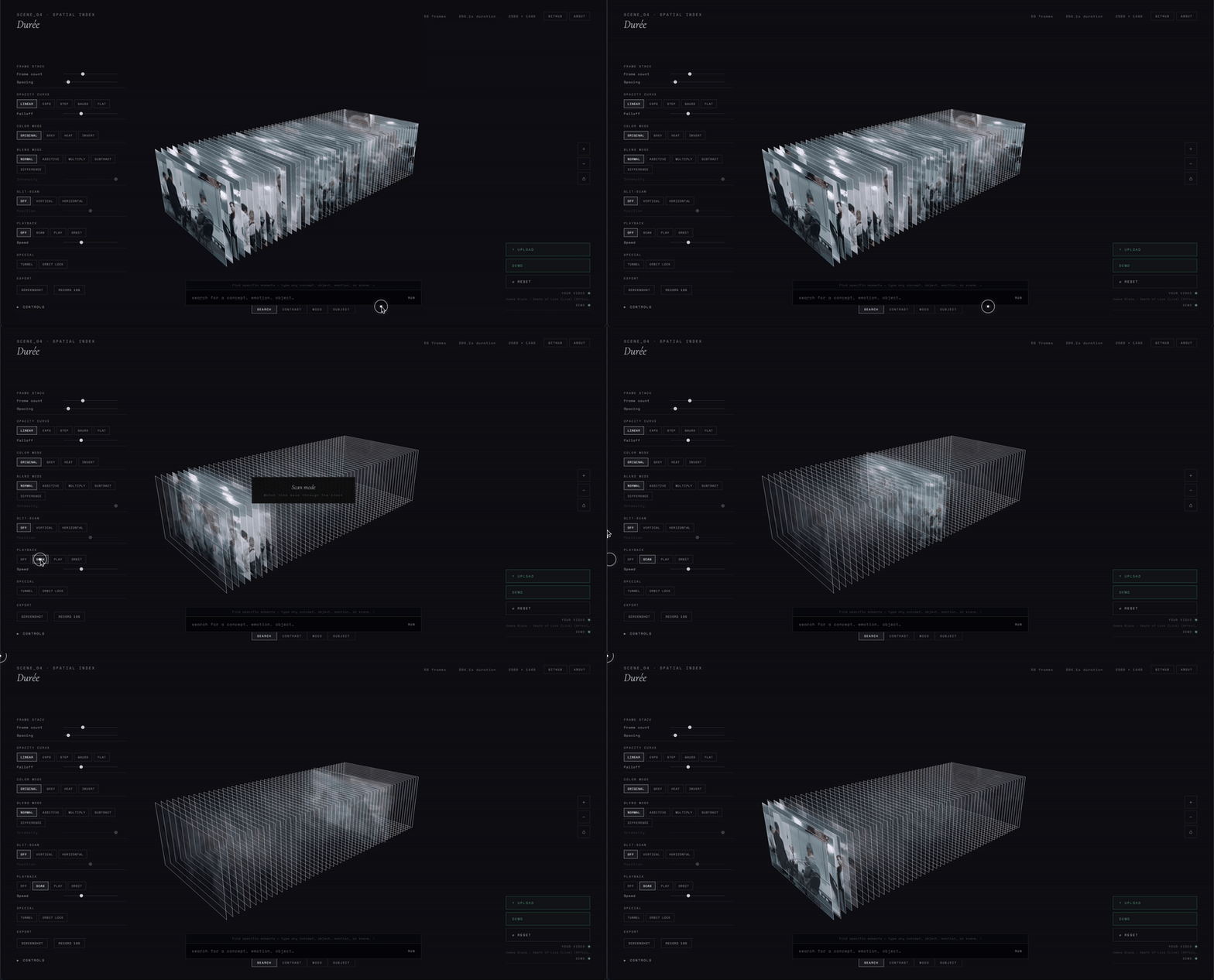
Duration translated into geometry.
The project inherits its name from Bergson’s sense of duration as lived, continuous time rather than a neutral sequence of discrete instants. In Durée, that intuition becomes visual and navigable: time is no longer hidden behind the playhead but built into the scene as depth.
At the same time, the work sits inside a contemporary browser stack. WebCodecs, shader logic, and multimodal search become tools for turning a familiar media object into a temporal sculpture that can still be queried and explored interactively.
Decode every frame, then stack the whole clip in 3D.
Durée renders all frames of a video simultaneously as semi-transparent planes distributed along a depth axis. Orbit controls let the viewer inspect the full stack from different angles, revealing density, repetition, and gesture across the clip as a single object.
WebCodecs handles browser-native frame extraction while GLSL manages the visual treatment of the stack. Gemini AI search sits on top of that structure so users can query the video by natural language and jump toward the regions that semantically match the prompt.
Temporal media decoded, stacked, and queried in-browser.
Search and visualization reinforce each other.
Durée made clear that semantic search becomes more legible when the media object itself is spatialized. Querying by language is useful, but seeing the matched region inside the full volume of a clip changes how retrieval is understood.
A likely next step is feeding this temporal object into later reconstruction projects, letting frame stacks become raw material for splat or accumulation pipelines instead of ending at visualization.